The Global Intelligence Crisis: Why Boardrooms Are Panicking Over Anthropic's Legal Tech
The phrase "global intelligence crisis" has been quietly circulating in corporate hallways and executive retreats lately. And it is not about a lack of human smarts. It is about a sudden, massive surplus of synthetic reasoning power.
For decades, the C-suite, senior legal partners, and board members thought their highly specialized, high-paying jobs were entirely insulated from software automation. Automation was supposed to be for data entry and assembly lines.
But the recent arrival of Anthropic's advanced legal software suite has radically changed the temperature in the room. We are now seeing a fundamental shift in how complex corporate logic is executed.
What Exactly Is Anthropic's Legal Suite?
To understand the panic, we have to look at what this software actually does. Anthropic's legal system is not a glorified search engine or a basic document redliner. It is a highly advanced cognitive reasoning tool.
Instead of just looking for keywords like "indemnity" or "liability," the algorithmic engine parses thousands of pages of complex contracts and synthesizes the contextual risk. It cross-references obscure jurisdictional case law against your company's specific vendor agreements.
And it does this in seconds.
With enterprise spending on cognitive automation projected to hit $85 billion in CapEx globally by the end of the year, executives are quickly realizing that human cognitive labor is becoming the most expensive bottleneck in the boardroom.
In Real Workflows: A First-Hand Look
In real workflows, teams notice an immediate shift in how document review is handled. You would think the software just speeds things up, but it actually changes the foundational questions we ask during due diligence.
When running a massive merger review last month, the system flagged a subtle indemnification clause hidden on page 400 of a legacy vendor agreement. We didn't even prompt it to look for that specific liability trap.
It recognized the structural risk based on the overarching corporate strategy we fed into its system. That level of proactive risk-flagging is something you usually only get from a seasoned partner charging $1,200 an hour.
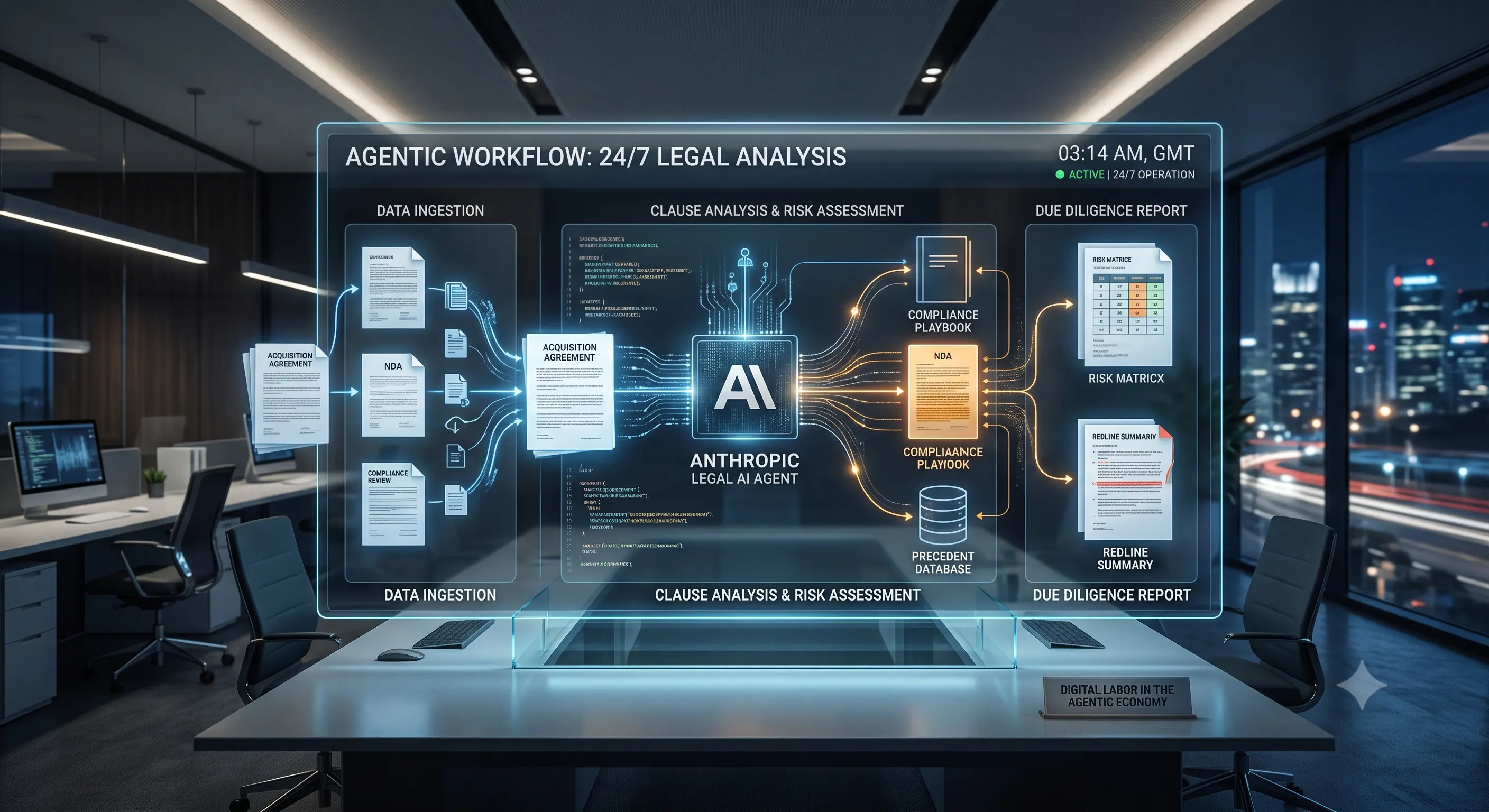
Step-by-Step: How Advanced Legal Automation Operates
So, how does a firm actually deploy this without breaking their existing operations? The integration usually follows a clear, phased approach.
- Phase 1: Ingestion. The firm connects its secure, localized servers to Anthropic's engine, feeding it years of past contracts, successful negotiations, and internal legal memos.
- Phase 2: Contextual Mapping. The software builds a structural map of the company's risk tolerance. It learns what clauses the legal team always rejects and which ones they typically compromise on.
- Phase 3: Active Drafting. When a new third-party contract arrives, the tool instantly generates a redlined version alongside a strategic memo explaining exactly why certain changes were made.
- Phase 4: Human Verification. A senior lawyer reviews the automated memo, verifies the logic, and finalizes the document for external sending.
[Internal Link: Integrating Enterprise Software Without Disrupting Workflows]
Mini Case Study: The M&A Due Diligence Race
Let's look at a concrete example of this global intelligence crisis playing out. A mid-sized tech firm recently acquired a regional logistics company. The target company had over 4,000 active, non-standardized vendor contracts.
Historically, an acquisition of this size would require a small army of junior associates working weekends for a month. They would manually log change-of-control provisions into massive spreadsheets.
Instead, the acquiring firm ran the entire data room through Anthropic's legal reasoning engine. The software categorized every contract, flagged 42 high-risk change-of-control clauses, and drafted renegotiation letters for each vendor.
The total processing time was just under three hours. The traditional law firm model, built heavily on the billable hour, fundamentally breaks down when faced with this kind of velocity.
Where This Breaks Down in Real Use
This sounds efficient, but in practice, things can get messy quickly if you blindly trust the automated output.
One issue that keeps coming up is the software's complete inability to read the "temperature" of a sensitive negotiation. It will ruthlessly redline a contract to protect your company to the maximum extent, striking out perfectly normal industry compromises.
If you take that heavily marked-up, aggressively defensive document and send it directly to opposing counsel, you will absolutely ruin the business relationship. The tool does not understand that sometimes, accepting a minor, calculated legal risk is the social grease required to close a lucrative partnership.
Who Should NOT Use This Software
Despite the hype, Anthropic's legal tool is not a magic bullet for everyone. There are specific environments where deploying this software is a waste of capital.
- Boutique Family Law Firms: Systems built for corporate M&A lack the emotional nuance and localized understanding required for delicate family disputes or mediations.
- Routine, High-Volume Processors: If your business only deals with simple, standardized NDAs or boilerplate waivers, an advanced cognitive engine is massive overkill.
- Small Local Government Practices: Municipal law often relies on unwritten local conventions and handshake precedents that algorithmic tools simply cannot access or comprehend.
Comparison: Traditional Workflows vs. Cognitive Engines
To truly grasp why boardrooms are restructuring their talent pipelines, we need to compare the old way of doing things with the new algorithmic reality.
| Workflow Aspect | Traditional Legal Teams | Anthropic's Legal Engine |
|---|---|---|
| Due Diligence Speed | Weeks to months of manual review. | Minutes to hours for complete parsing. |
| Cost Structure | High hourly billing; expensive overhead. | Fixed licensing fees; low marginal cost. |
| Error Rate | Increases with fatigue and late nights. | Consistent baseline, though prone to context errors. |
| Strategic Empathy | High. Lawyers understand relationship dynamics. | Zero. Purely literal and logically rigid. |
According to recent industry analysis by Reuters Legal, firms that fail to adapt their billing models to this new speed reality risk losing major corporate clients within the next fiscal year.
The Real Reason Behind the Boardroom Panic
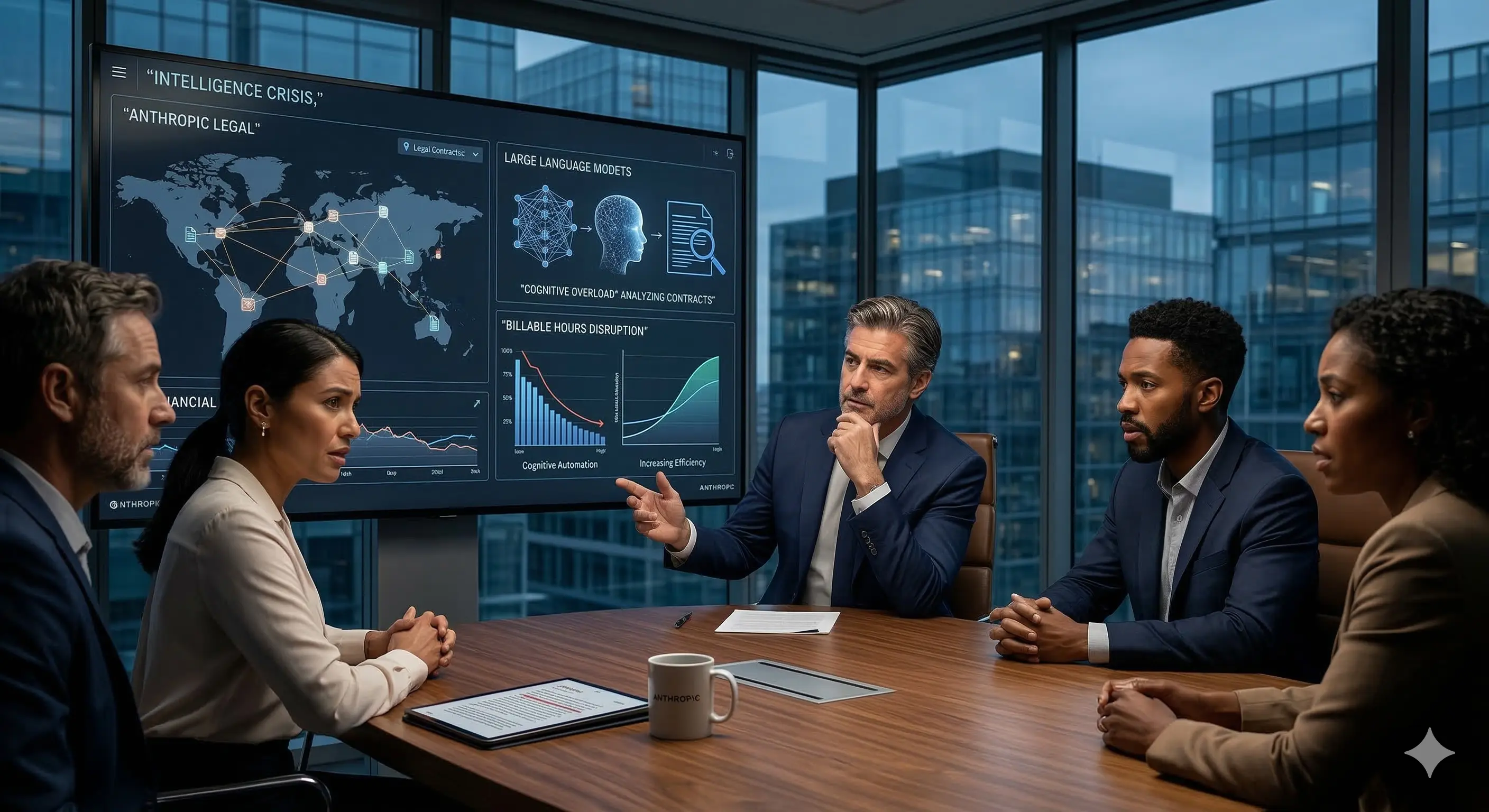
The intelligence crisis isn't just about junior employees losing their jobs. It is about the partners at the top.
Law firms and corporate consultancies operate on a pyramid model. You hire twenty junior associates to do the grueling, time-consuming research, and you bill their time at a premium. The partners at the top take the profits from that base layer of labor.
When software instantly does the work of those twenty juniors, the pyramid collapses. Corporate clients know the technology exists. They are no longer willing to pay $400 an hour for a junior associate to read contracts when a software license can do it instantly.
Boardrooms are panicking because their entire revenue structure, and their justification for massive executive compensation, is suddenly highly transparent and easily bypassed.
Frequently Asked Questions
Is Anthropic's legal software replacing lawyers entirely?
No. It replaces the tedious, repetitive research and parsing tasks. Senior lawyers are still strictly required for strategy, negotiation, and final client counseling.
Can the software appear in court?
Absolutely not. The software is a backend analytical tool. It cannot represent clients, make oral arguments, or hold a legal license in any jurisdiction.
How secure is corporate data when using these systems?
Enterprise versions of these tools usually offer "zero-retention" policies. This means the software processes your sensitive contracts without storing them or using your private corporate data to improve the global public system.
Why is it called an intelligence crisis?
Because the scarcity of high-level analytical reasoning is ending. Companies are struggling to redefine the value of their human executives now that complex logic is cheap and abundant.
Does this software work for non-US law?
It is primarily optimized for US and UK corporate law due to the massive availability of digitized legal precedents in those regions. Performance drops significantly in jurisdictions with highly localized or non-digitized codes.
The transition into cognitive corporate software requires a careful balance. You have to leverage the speed of the engine while maintaining the strategic empathy of a human operator. Take the time to audit your current legal bottlenecks and run a small, controlled pilot program with a single department before restructuring your entire workflow.
Disclaimer: The information provided in this article is for educational and informational purposes only and does not constitute legal, financial, or professional advice. Always consult with a qualified legal professional regarding your specific compliance and contract needs.