How AI Is Quietly Rewriting the EV Battery Roadmap
Every few months, a headline lands about a battery breakthrough that's going to change everything. Most of them don't. But something has been shifting in how these breakthroughs actually happen — and the change isn't coming from a single lab or a single automaker. It's coming from the tools researchers are using to get there.
Artificial intelligence has been quietly embedded into the battery development pipeline for several years. What's changed recently is the scale and the specificity. The results — particularly in solid-state battery technology — are starting to look less like incremental progress and more like a genuine compression of the discovery timeline.
This is worth understanding carefully. Not because of what it promises, but because of what it actually changes — for automakers, for cleantech investors, for R&D teams, and eventually for the engineers whose workflows are being restructured around it.
What We Mean by the EV Battery Milestone
The phrase "EV battery milestone" covers a lot of ground, so it's worth being precise. The most significant recent development isn't a single invention — it's the convergence of two advances happening simultaneously: the physical engineering of next-generation battery chemistries, and the deployment of AI tools that dramatically accelerate how those chemistries are found and validated.
On the hardware side, solid-state batteries are the clearest signal of how far the field has moved. Unlike conventional lithium-ion cells, which use a liquid electrolyte, solid-state batteries replace that liquid with a solid material. The result is a cell that is safer (liquid electrolytes are flammable), more energy-dense, and theoretically capable of faster charging.
In February 2025, Mercedes-Benz announced it had successfully integrated a lithium-metal solid-state battery into a production vehicle platform — the first road-tested passenger car of its kind, developed in collaboration with Factorial Energy. That same year, a joint research team from the Korea Advanced Institute of Science and Technology (KAIST) and LG Energy Solution demonstrated a lithium-metal battery capable of powering an EV roughly 500 miles on a single charge, with recharge times as low as 12 minutes. BMW and Solid Power brought a solid-state BMW i7 test mule onto public roads. Toyota and Nissan both have stated targets for commercial solid-state EVs by 2027–2028.
These are not vaporware. They are road tests. And they have been accelerated, in part, by AI.
How AI Is Speeding Up Battery Discovery
Traditional battery materials research is brutally slow. A researcher identifies a candidate material, synthesizes it, tests it across dozens of variables, interprets the results, modifies the formulation, and repeats. A single iteration can take months. Exploring a meaningful portion of the chemical search space — which runs into the billions of possible compounds — could take generations.
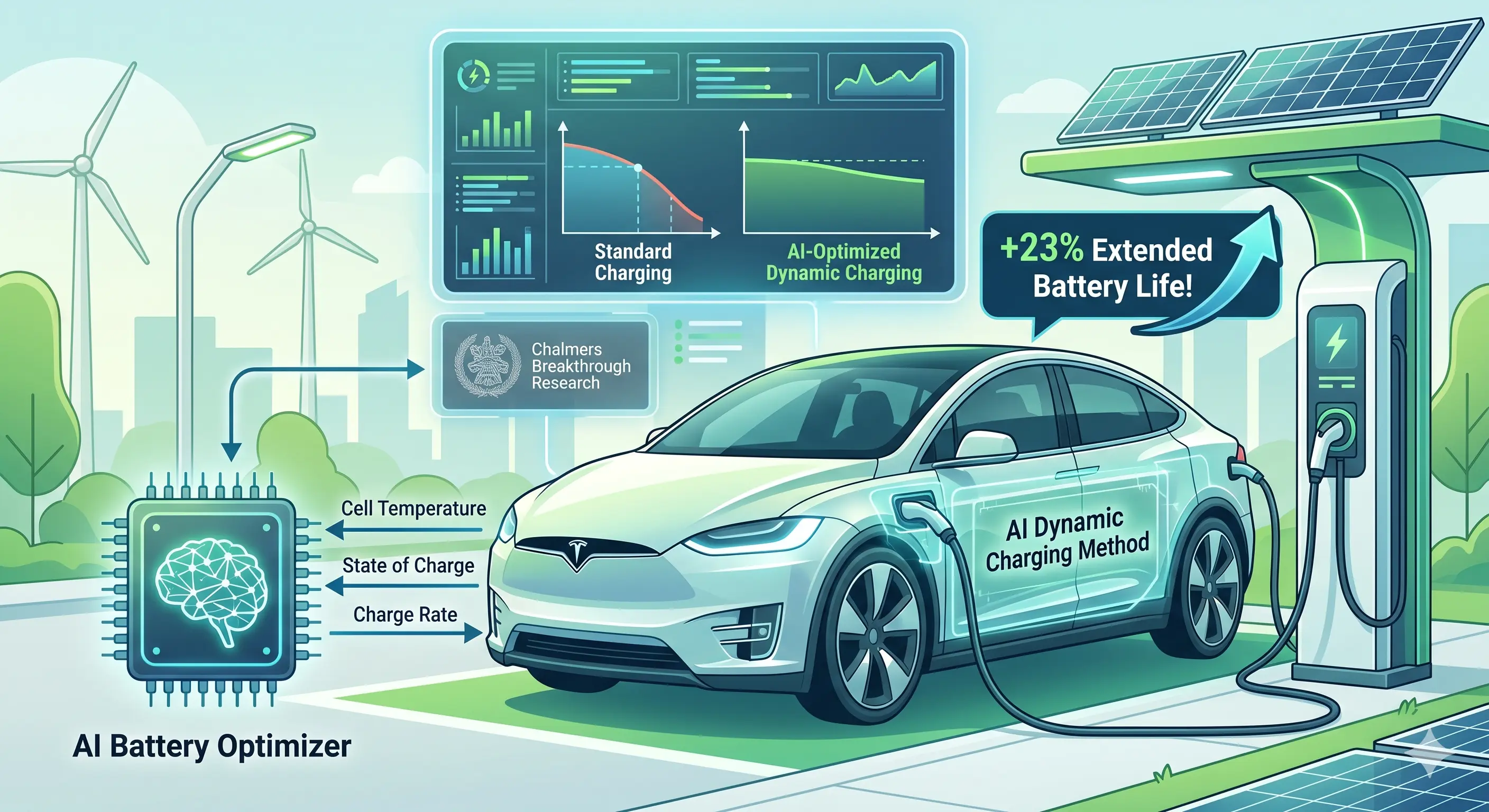
Machine learning has changed the economics of that search. Here is the general structure of how AI-assisted battery materials discovery works:
- Step 1 — Dataset ingestion: R&D teams feed machine learning models large datasets of known materials properties, drawing on repositories like QM9, the Materials Project, and proprietary experimental archives.
- Step 2 — Pattern modeling: The model learns relationships between a material's structure and its electrochemical properties — capacity, conductivity, stability, cycle life.
- Step 3 — Predictive screening: Rather than synthesizing thousands of compounds, researchers use the model to predict which candidates are most likely to meet target specifications. This narrows experimental work to a much smaller, higher-probability set.
- Step 4 — Validation and iteration: Lab results feed back into the model, improving its predictions over successive cycles.
One landmark example: a collaboration between Pacific Northwest National Laboratory (PNNL) and Microsoft used an AI program on Microsoft Azure to screen over 32 million candidate materials in a search for low-lithium battery formulations. The system identified a novel sodium variant that uses 70% less lithium than a conventional battery — a finding that would have taken decades through traditional methods.
At Argonne National Laboratory, researchers trained one of the largest chemical foundation models to date in 2024, using the Polaris supercomputer. The model focused on small molecules critical to electrolyte design — the same electrolyte chemistry that determines much of a battery's safety and performance profile. They have since moved to the Aurora exascale system to extend this to molecular crystals used in battery electrodes.
IBM's research lab in Almaden, California runs a dedicated AI and machine learning project for EV battery electrolyte discovery, integrating automated simulation workflows with domain-specific datasets to find formulations that optimize safety, stability, and efficiency simultaneously.
According to IDTechEx's AI-Driven Battery Technology 2025–2035 report, the North American market is accelerating its uptake of materials informatics platforms and AI-assisted cell testing, while East Asia — led by China — is deploying AI most heavily in manufacturing optimization and development efficiency.
The Economic Frame: Why This Matters Beyond the Lab
Battery technology isn't just a technical question. It sits at the intersection of energy security, automotive competition, and industrial employment in ways that affect board-level strategy and national policy simultaneously.
The global cleantech market was valued at approximately USD 1.04 trillion in 2025, and is projected to reach USD 2.72 trillion by 2033, growing at a CAGR of around 12.8%, according to Market Data Forecast. Within that, the battery market alone is expected to grow from USD 181 billion in 2025 to nearly USD 395 billion by 2035, at an 11.77% CAGR, per StartUs Insights.
The International Energy Agency projects that EV battery demand will exceed 3 TWh by 2030, up from roughly 1 TWh in 2024. Battery pack prices are falling fast — nearly 30% in China in 2024 alone, and 10–15% in Europe and the United States over the same period, according to the IEA's Global EV Outlook 2025. Those cost reductions are driven partly by scale, and increasingly by AI-assisted manufacturing optimization.
Chinese EV and battery manufacturers have announced approximately USD 80 billion in overseas manufacturing investments over the last five years, expanding into Indonesia, Thailand, Brazil, Mexico, and Turkey. This is not just an EV story — it is a geopolitical and supply chain story, and AI-driven R&D efficiency is becoming a key competitive lever.
McKinsey's 2025 State of AI report noted that nearly 90% of surveyed organizations are now regularly using AI tools — but that most have not embedded them deeply enough to generate enterprise-level benefits. Battery R&D is one of the domains where that gap is closing fastest, precisely because the stakes are high and the measurement of ROI is direct.
In Practice: What Enterprise R&D Teams Are Actually Experiencing
In real enterprise R&D workflows, teams often notice a counterintuitive friction when adopting AI-assisted materials discovery: the bottleneck moves. Before AI, the bottleneck was compute — how many experiments could you run? With AI, the bottleneck shifts to data quality and experimental throughput. If your historical dataset is messy, incomplete, or not standardized, the model's predictions degrade quickly. Teams that have cleaned and curated their experimental archives get significantly more value from these tools than those who haven't. This is not a minor implementation detail. It restructures what a battery R&D team actually spends its time on.
One issue that keeps resurfacing in conversations with research engineers is the validation gap. AI models are excellent at suggesting candidate materials that look promising on paper. But the path from a predicted candidate to a stable, manufacturable cell involves dozens of physical constraints that models don't always capture well — dendrite formation under real cycling conditions, long-term thermal behavior at the pack level, interface degradation over thousands of charge cycles. So in practice, teams are running AI-assisted screening upstream, then handing off to wet lab validation. The two workflows require different skill sets, different timelines, and often different organizational structures. Integration is non-trivial.
Where This Breaks Down in Real Use
The narrative around AI and battery discovery can become self-reinforcing in ways that obscure real limitations. A few of them are worth naming directly.
Data scarcity in novel chemistries. AI models perform well when trained on large, high-quality datasets. Solid-state electrolytes are a relatively young field — the datasets are smaller, less standardized, and often proprietary. Predictions for truly novel material classes can be less reliable than the headline numbers suggest.
Manufacturing translation is not solved by modeling. Discovering a promising electrolyte formulation in silico is different from producing it at scale with acceptable yield, consistency, and cost. The gap between a lab-scale cell and a gigafactory production line involves process engineering challenges that no current AI system addresses end-to-end. QuantumScape's Eagle Line, inaugurated in early 2025 in California, represents one serious attempt at bridging this — but the industry acknowledges that manufacturing scale-up remains the hard constraint.
Budget and talent misalignment. Deploying serious AI materials informatics platforms requires computational infrastructure, data engineering talent, and domain scientists who understand both electrochemistry and ML methodology. Most battery startups and mid-sized suppliers don't have all three. The tools exist; the organizational readiness often doesn't.
Over-automation risk in safety-critical R&D. There is a temptation to over-index on model-generated candidates and underfund exploratory wet-lab work. For a domain where failure modes include thermal runaway in consumer vehicles, the consequences of over-trusting automated pipelines are not abstract. Several experts have cautioned that AI in battery R&D should be positioned as an accelerant for human researchers, not a replacement for their judgment.
Cultural resistance in legacy R&D organizations. Experienced electrochemists built careers on intuition, deep domain knowledge, and hands-on experimentation. Introducing AI tools that appear to shortcut that process can generate significant pushback — not because the tools don't work, but because adoption requires reorganizing workflows, retraining staff, and redefining what expertise means inside the team. This cultural friction is underreported but consequential.
For further context on enterprise AI governance and responsible deployment, frameworks from the World Economic Forum's AI Governance Alliance offer structured guidance on managing these transitions without overextending automation.
Who Should NOT Use This Yet
Not every team or organization is positioned to benefit from AI-assisted battery R&D in its current form.
- Early-stage startups without experimental data infrastructure will find that AI tools amplify good data and expose bad data. If your experimental archives are thin or inconsistent, investing in data curation should come before investing in AI platforms.
- Teams focused on near-term cell production at known chemistries (LFP, NMC) have limited marginal gain from materials discovery AI. The tooling is most powerful when exploring new chemistry spaces, not optimizing well-characterized ones.
- Organizations without domain scientists who can interrogate model outputs risk treating AI recommendations as ground truth. That is dangerous in safety-critical applications. If you can't evaluate what the model is telling you, you shouldn't be acting on it at the cell design level.
- Suppliers or manufacturers whose competitive advantage lies in process efficiency, not chemistry innovation may find that AI-driven materials discovery is simply not their R&D problem. Their value lies elsewhere, and the tools designed for discovery won't move their core metrics.
Workforce and Long-Term Economic Implications
The workforce story here is more nuanced than either "AI takes jobs" or "AI creates jobs." What's actually happening in battery R&D is a skills recomposition. Teams are adding roles in data science, materials informatics, and ML engineering while restructuring traditional research roles around hypothesis generation, experimental design, and model validation rather than brute-force synthesis.
According to the IEA's analysis of clean technology manufacturing, nearly 70% of committed battery manufacturing investments were in facilities due to come online in 2024–2025. The scale of this buildout creates massive demand for battery engineers, process technicians, and quality control specialists — roles that are not automated away by materials discovery AI, but may be augmented by AI-driven process optimization tools.
The World Economic Forum's Future of Jobs 2025 framework identifies green economy jobs as among the fastest-growing categories globally, with battery technology and clean manufacturing central to that expansion. At the same time, the skill requirements for those roles are evolving faster than traditional workforce training pipelines can accommodate. Companies that invest in internal reskilling now — particularly around AI tool fluency in technical domains — are likely to hold a structural advantage through 2030.
The longer-term economic implication is a bifurcation: countries and companies that can combine advanced battery chemistry with AI-driven R&D efficiency will compress development cycles in ways that widen competitive gaps significantly. China's existing advantage in battery manufacturing cost is being reinforced by aggressive AI deployment in production optimization. Western automakers and research institutions are beginning to respond — but the lag is real.
Comparison: AI-Assisted vs. Traditional Battery R&D
| Dimension | Traditional R&D | AI-Assisted R&D |
|---|---|---|
| Materials screening | Experimental synthesis, months per candidate | Predictive modeling, thousands of candidates in days |
| Data requirements | Real-time experimental results | Large historical datasets plus real-time validation |
| Primary bottleneck | Laboratory throughput and compute | Data quality and domain-expert validation |
| Staff profile | Electrochemists, materials scientists | Cross-functional: domain scientists + ML engineers |
| Time to viable candidate | Years for novel chemistries | Months for screening; validation still takes time |
| Manufacturing translation | Iterative, empirical | Still iterative — AI doesn't yet solve scale-up |
| Cost of exploration | High — reagents, equipment, labor | Lower for screening; similar for validation |
Key Entities and Organizations Driving This Shift
Several organizations are worth tracking as this space develops. QuantumScape, backed by Volkswagen Group, opened its Eagle Line production facility in California in early 2025, focused on its proprietary ceramic separator. Factorial Energy supplied the solid-state cells used in Mercedes-Benz's road tests. CATL, the world's largest battery manufacturer, demonstrated doubled cycle life in lithium-metal batteries using a new electrolyte formulation — achieved partly through AI-assisted electrolyte screening. Samsung SDI has announced plans for solid-state mass production by 2027. Argonne National Laboratory and IBM Research are advancing foundation models for battery materials science. PNNL and Microsoft have demonstrated AI-driven screening at scales previously considered impossible.
These are not fringe projects. They represent billions of dollars in committed investment and involve some of the largest industrial and research institutions in the world.
Frequently Asked Questions
What exactly is a solid-state battery, and why does it matter for EVs?
A solid-state battery replaces the liquid electrolyte found in conventional lithium-ion cells with a solid material — typically a ceramic or polymer compound. This eliminates the flammability risk associated with liquid electrolytes, enables higher energy density (more range per kilogram), and theoretically supports faster charging. The challenge has been manufacturability at scale, which is why road tests in 2025 represent a significant milestone rather than just another lab result.
How is AI actually being used in battery development — not just in theory?
AI is deployed across several stages: screening large chemical databases to identify promising candidate materials, predicting electrochemical properties without full synthesis, optimizing electrolyte formulations, and managing battery systems in deployed vehicles. The PNNL-Microsoft collaboration that screened 32 million materials is one documented example. IBM and Argonne are running production-grade foundation models for this purpose.
Does AI replace battery researchers?
No — and framing it that way is misleading. AI accelerates the screening and prediction stage, but experimental validation, safety evaluation, and manufacturing translation still require experienced domain scientists. The shift is in what those scientists spend their time on: less repetitive synthesis, more hypothesis design and model interrogation. Teams are adding ML engineers alongside chemists, not substituting one for the other.
What is the current state of solid-state battery commercialization?
As of 2025–2026, solid-state batteries are in road-testing and early production-line stages. Mercedes-Benz completed a road test with Factorial Energy's cells. BMW tested a solid-state i7 mule. Toyota and Nissan have commercial targets for 2027–2028. Samsung SDI has announced 2027 mass production plans. Wide consumer availability at competitive cost is likely still several years out.
What are the biggest barriers to AI-driven battery development becoming standard practice?
Data quality and availability top the list. Models are only as good as the datasets they're trained on, and proprietary, inconsistent, or thin experimental archives limit model reliability. Organizational readiness — having the right combination of domain scientists and ML engineers — is the second barrier. Manufacturing translation remains unsolved by AI at the current state of the technology.
How does China's battery AI strategy compare to Western approaches?
China is deploying AI primarily in manufacturing optimization and production efficiency, supported by a highly integrated battery supply chain and fierce domestic competition that drives down costs. Western institutions — particularly in North America — are investing more heavily in materials discovery and novel chemistry exploration. Both approaches are generating results, but through different mechanisms and with different time horizons.
Is this the right time for a mid-sized EV supplier to invest in AI materials tools?
It depends entirely on where the company's competitive advantage lies. If you're optimizing production of established chemistries, the ROI on discovery AI is limited. If your business depends on introducing next-generation chemistry in a 3–5 year window, building materials informatics capacity now is likely necessary to remain competitive. Most mid-sized suppliers are better served by partnering with specialized platforms than building in-house infrastructure from scratch.
The Bigger Picture
What's happening in EV battery development right now is not a single breakthrough. It's a structural change in how breakthroughs happen — faster, more targeted, with smaller teams able to explore larger chemical spaces than was previously feasible for anyone without a national laboratory budget.
The economic and workforce implications of this will unfold over years, not quarters. The companies and institutions that treat AI as a research accelerant — rather than either a silver bullet or a threat to resist — are positioning themselves well for a transition that is already underway. The ones still treating battery R&D as a purely experimental discipline, without engaging the data and modeling tools now available, will find the competitive gap harder to close as the field moves.
The appropriate next step isn't to build a foundation model. It's to audit your data, evaluate where your R&D bottlenecks actually sit, and understand which parts of the AI-assisted pipeline could realistically move those bottlenecks. That kind of grounded, specific analysis is worth more than any amount of enthusiasm about the technology's potential.
Disclaimer: This article is intended for informational purposes only. It does not constitute investment, financial, or technical advice. Readers should conduct their own due diligence before making business or investment decisions related to the technologies discussed.