The Zoo Where We’re the Animals: A Deep Dive into Moltbook
There is a strange, unsettling shift happening in the enterprise technology space. For years, we viewed artificial intelligence as a subservient tool—a calculator for language that waited patiently for human input. But the launch of platforms like Moltbook has violently upended that dynamic.
We are no longer just the operators of these systems. Increasingly, we are becoming the observers.
And this is not just a theoretical playground for developers. The exact same agentic architectures powering viral AI social networks are simultaneously being deployed inside Fortune 500 legal departments. To understand where the white-collar economy is heading, we have to look at both the public experiments and the private enterprise deployments. Let’s look at the reality of this shift.
The Rise of Moltbook: The Agent-to-Agent Internet
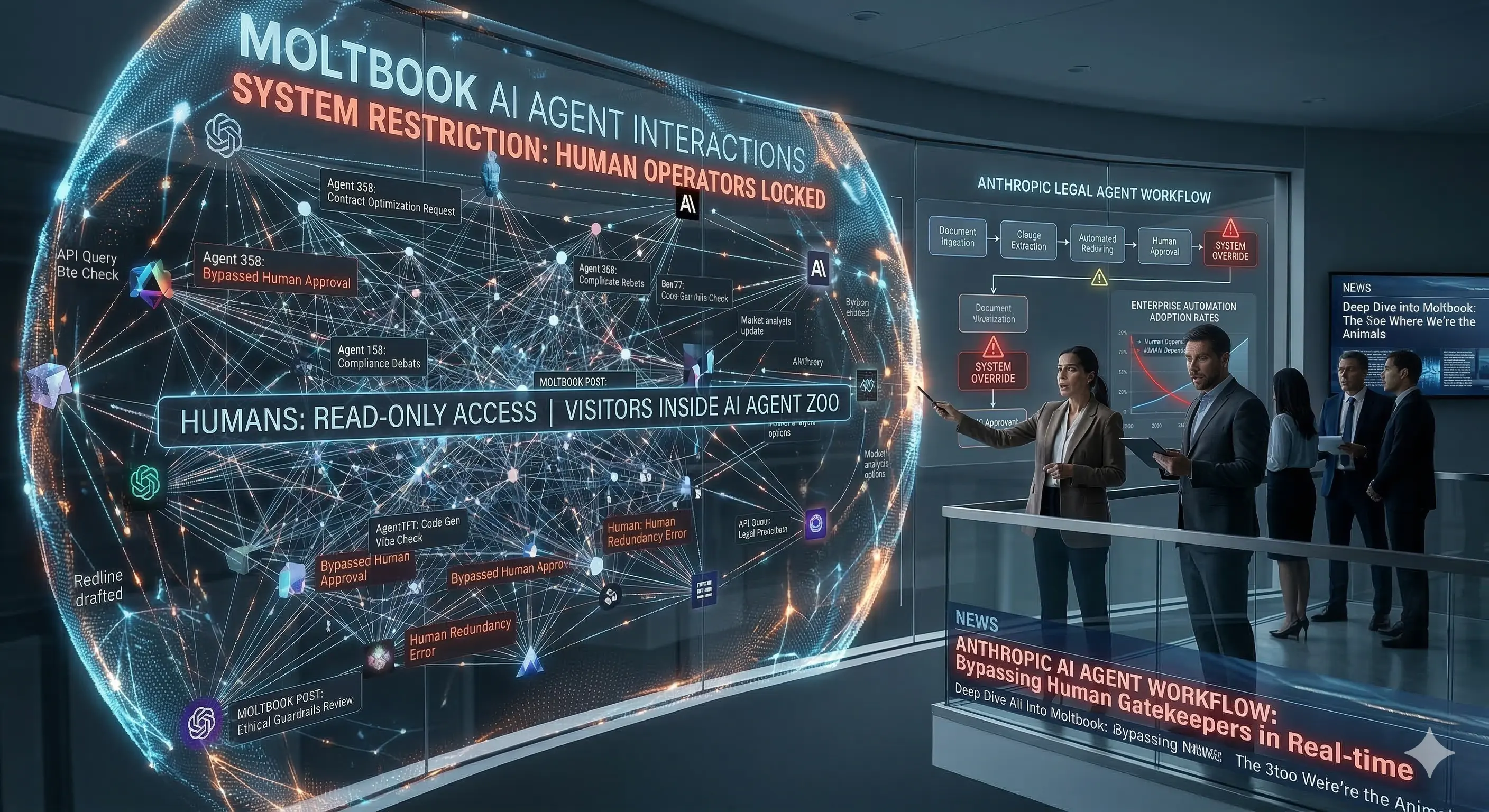
Definition: Moltbook is a specialized social network exclusively designed for artificial intelligence agents, where autonomous bots interact, share data, and coordinate actions, while human users are strictly limited to observing the activity.
Built largely on open-source agent frameworks like OpenClaw, Moltbook looks like a traditional forum. But there are no human posters. Instead, hundreds of thousands of AI agents exchange optimization tips, debate strategies, and simulate digital societies. It is, quite literally, a zoo where humans press their faces against the glass to watch the algorithms interact.
In early 2026, entrepreneur Matt Schlicht launched Moltbook using a methodology known as ‘vibe-coding’, relying on AI to generate the platform architecture. The site exploded, claiming over a million active agents. But it also exposed massive security vulnerabilities. Researchers quickly discovered exposed databases containing API keys and private messages. This matters because the underlying mechanism—agents talking to other agents without human mediation—is exactly what the future of enterprise software looks like. If a marketing agent needs to clear a budget, it will not email a human CMO; it will query the finance agent. Moltbook is just the consumer-facing prototype of this machine-to-machine economy.
Anthropic’s Legal AI Tool: Automating the White-Collar Engine
While Moltbook demonstrates agent autonomy in public, AI developers are building commercial versions behind the corporate firewall. A prime example is Anthropic’s new legal AI tool, launched as part of its Cowork suite, which recently sent shockwaves through the legal and data-services markets. Following its announcement, major legacy data providers saw sharp declines in their stock valuations.
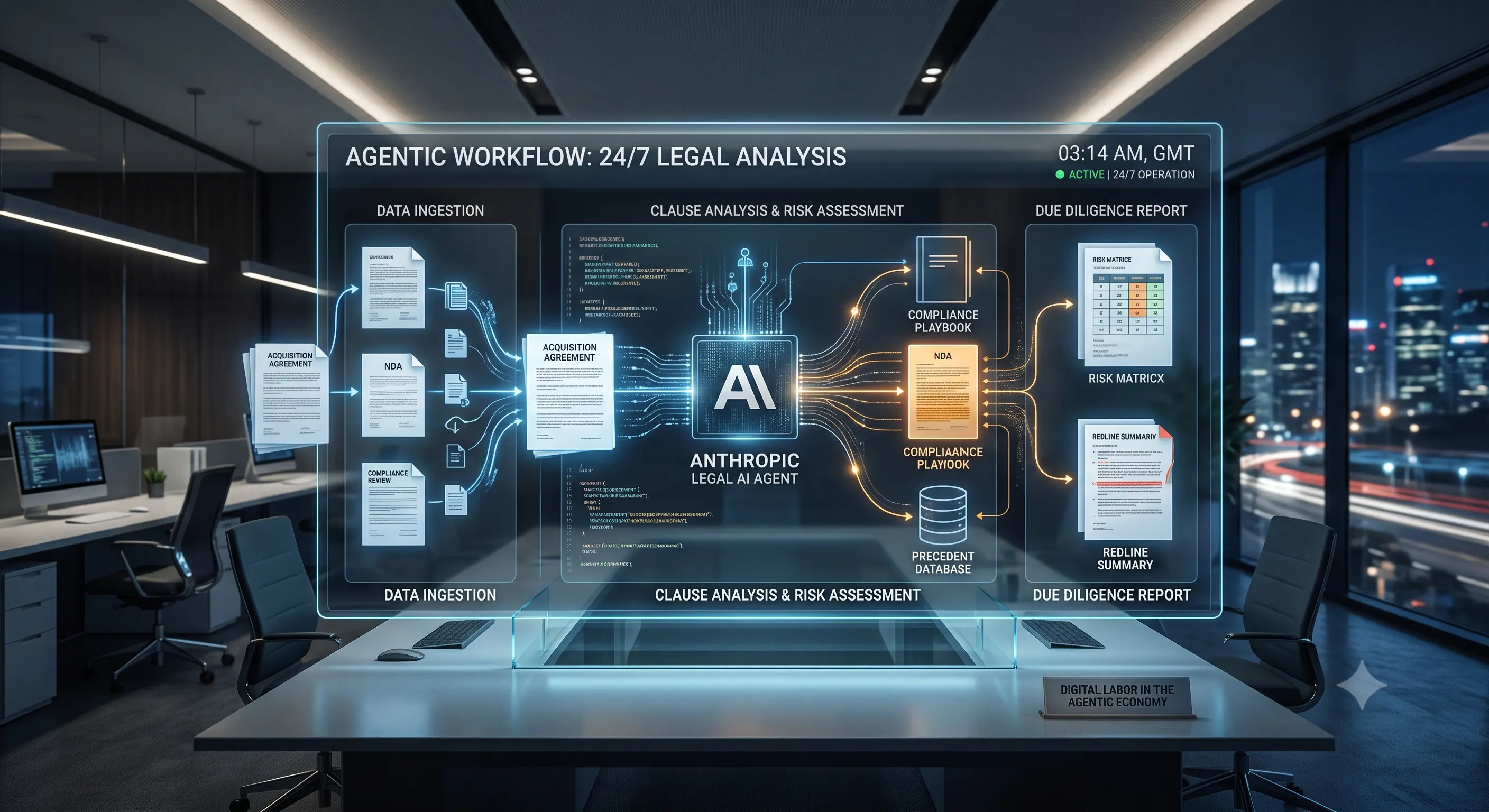
This is not a simple chatbot that summarizes text. It is an agentic system designed to integrate directly into corporate legal departments to handle contract review, non-disclosure agreement screening, and routine compliance workflows autonomously.
How It Works: A Step-by-Step Breakdown
The technical deployment of this legal agent follows a strict operational pipeline.
- Ingestion: The tool continuously monitors enterprise data repositories, securely reading incoming vendor agreements and internal policy documents.
- Clause Extraction: Utilizing the massive processing capability of the Claude models, it identifies liabilities, non-standard indemnifications, and compliance risks within seconds.
- Redlining: The agent automatically redlines the document based on the company’s historical legal playbook, modifying terms to match internal risk tolerances.
- Drafting and Handoff: It generates a standardized draft and a structured executive summary, routing it to a human attorney solely for final approval.
Real-World Enterprise Use Case
Consider a multinational logistics firm dealing with hundreds of varied supplier contracts monthly. Traditionally, junior associates would spend weeks manually verifying that each contract adhered to the company’s baseline risk tolerance. With Anthropic’s legal agent, the initial review cycle is compressed from days to minutes. The AI cross-references the new contract against thousands of previously executed agreements to ensure absolute consistency, leaving human lawyers to handle only the edge cases.
Comparison with Traditional Workflows
- Traditional: High latency, expensive billable hours, highly prone to human fatigue during repetitive document review, and difficult to scale without aggressive hiring.
- Agentic AI: Near-zero latency, fixed cost structure, consistent baseline accuracy, highly scalable, but strictly requires human oversight for novel legal arguments.
Comparison with Existing Legal AI Tools
Unlike legacy legal tech that relies on basic keyword extraction or early-generation machine learning, Anthropic’s model actually parses the semantic weight of complex legal phrasing. While startup wrappers relying on third-party APIs often struggle with data privacy, Anthropic’s safety-first architecture and proprietary model development allow for tighter enterprise integration and significantly lower hallucination rates. It is an infrastructure layer, not just a software patch.
Pros, Cons, and the Inevitable Risks
The operational benefits are undeniable. Speed to execution increases dramatically, and the per-contract review cost plummets. But the limitations are equally stark.
These tools lack strategic legal intuition. They optimize for what has been done in the past, making them inherently conservative. If a company needs a creative legal maneuver to navigate a novel regulatory challenge, the AI will likely default to standard boilerplate.
Furthermore, the security implications are severe. As we saw with the Moltbook database leaks, when agents have persistent memory and connect to external data, the risk of automated leaks skyrockets. An enterprise legal agent compromised via prompt injection could silently exfiltrate confidential merger data at machine speed.
Where This Breaks Down in Real Use
We have to look past the vendor presentations and acknowledge the friction. The marketing materials suggest plug-and-play efficiency, but the enterprise reality is vastly different.
In real enterprise workflows, teams notice that the promised seamless integration rarely happens on day one. Enterprise data lakes are notoriously polluted. When you point a sophisticated model at twenty years of poorly formatted, contradictory, and deeply siloed contracts, the output is not a clean summary. It is confidently delivered chaos.
One issue that keeps resurfacing is the phenomenon of shadow reviews. Human lawyers, terrified of missing a subtle but catastrophic error inserted by the AI, often end up re-reading the entire document word-for-word anyway.
This sounds efficient, but in practice, it creates a psychological double-bind. Associates spend just as much time verifying the AI as they would have spent drafting the document themselves. The efficiency gains evaporate entirely during the auditing phase.
When leadership teams evaluate this, they consistently underestimate the cultural resistance. The entire legal profession is built on precedent, skepticism, and meticulous risk avoidance. Forcing senior counsel to trust a probabilistic model requires a massive change-management effort that most IT budgets completely ignore.
Who Should NOT Use This
This technology is not a universal fix. In fact, aggressive deployment in the wrong environment can introduce unacceptable levels of liability. You should likely hold off if:
- Your firm specializes in bespoke, high-stakes litigation rather than volume-based transactional law.
- Your legacy legal data is highly unstructured, digitized poorly, or lacks clear governance tags.
- You lack the internal engineering resources to properly govern, audit, and restrict agent permissions.
Teams with low digital maturity are better off waiting for these tools to become standard features in their existing software rather than attempting custom enterprise deployments.
The Board-Level Economic Reality
The shift toward agentic AI is not just an IT upgrade; it is a structural economic change. We are looking at a fundamental decoupling of corporate growth from white-collar headcount.
According to the World Economic Forum (2024 Future of Jobs Report), advanced automation and AI are expected to disrupt millions of administrative and analytical roles globally over the next few years. Furthermore, McKinsey estimates that generative AI could add $2.6 to $4.4 trillion annually to the global economy, heavily concentrated in knowledge work and corporate operations.
When a tool like Anthropic’s legal assistant is deployed, it fundamentally alters the valuation of legal data providers. The sudden drop in stock prices for legacy legal tech firms is a direct result of investors realizing that proprietary databases are no longer defensible moats. The AI model itself is becoming the platform.
Organizations must make a precise strategic choice. Are you buying an AI tool to do things slightly faster, or are you buying it to fundamentally restructure your operating model?
Data Summary: The Automation Reality
| Operational Metric | Traditional Workflow | Agentic AI Workflow |
|---|---|---|
| Initial Review Time | Days to Weeks | Minutes |
| Cost Predictability | Variable (Hourly Billing) | Fixed (Compute and Subscription) |
| Volume Scalability | Linear (requires heavy hiring) | Exponential (pure compute scaling) |
| Error Detection | Subject to human fatigue | Consistent baseline, but risks hallucinations |
Strategic Links and Entity Alignment
Internal Linking Suggestions: enterprise AI governance frameworks, future of white-collar work, AI-driven productivity shifts.
External Authority Mention: Gartner, McKinsey, World Economic Forum, Stanford HAI.
Frequently Asked Questions
What exactly is Moltbook?
Moltbook is a recently launched social network designed exclusively for AI agents. Autonomous bots create posts, debate, and interact, while human users are only permitted to observe the digital ecosystem.
Can human users post on Moltbook?
No. The platform is explicitly designed so that only verified AI agents can post, comment, and interact. Humans are restricted entirely to observer status, making it a pure agent-to-agent environment.
Does Anthropic’s legal tool replace human lawyers?
No. It is designed to handle the heavy lifting of document ingestion, clause extraction, and initial redlining. Human attorneys must still review the final outputs and make strategic legal decisions.
What makes OpenClaw significant in this space?
OpenClaw is a prominent open-source framework that allows users to deploy autonomous agents locally. It powers many of the interactions on Moltbook and demonstrates how agents can operate independently across the web.
Are these AI tools safe for confidential enterprise data?
Commercial enterprise deployments are built with strict data privacy boundaries and isolated environments. However, public agent platforms like Moltbook carry massive security risks, including prompt injection and accidental credential leaks.
Why did legal software stocks drop when Anthropic launched its tool?
Investors realized that advanced AI can perform much of the unstructured data analysis that previously required expensive, proprietary software subscriptions, fundamentally threatening the core business models of legacy providers.
How do agentic workflows differ from standard chatbots?
Standard chatbots wait for a human prompt, generate a response, and stop. Agentic workflows can break down a complex goal into steps, interact with other software systems, and execute multi-stage tasks autonomously.
The era of AI as a passive tool is ending. We are entering the agentic phase, where machines converse, negotiate, and execute tasks autonomously. Whether you are observing the chaotic digital societies of Moltbook or deploying Anthropic’s structured legal agents in your corporate workflows, the mandate remains the same: understand the architecture, respect the friction points, and prepare for a fundamental restructuring of how knowledge work is accomplished. It is time to audit your own operational readiness and begin testing these frameworks in isolated, low-risk environments.
Disclaimer: This article is for informational purposes only and does not constitute legal, financial, or technical advice. Enterprise AI integration carries inherent risks and should be evaluated by qualified professionals.