The Distillation War: How Tech Labs Are Accused of Cloning Claude
Building a frontier neural network from scratch requires an astronomical amount of capital. We are talking about hundreds of millions—often billions—of dollars poured into massive Nvidia GPU clusters, advanced cooling infrastructure, and years of specialized engineering. But what happens when an organization wants that top-tier reasoning capability without paying the billion-dollar price tag? They look for a shortcut.
Right now, the technology sector is quietly battling over exactly this kind of shortcut. Several prominent Chinese tech labs are currently facing heavy accusations of essentially scraping Anthropic's Claude to build their own rival systems. This practice is known in the industry as 'distillation,' and it is setting off alarm bells across the enterprise software space.
And while it might just sound like corporate espionage as usual, the implications are massive. To understand why this matters, we have to look closely at how these advanced systems are being utilized in high-stakes environments, particularly within enterprise legal tech and compliance workflows.
What Exactly is System Distillation?
To grasp the controversy, we first need to strip away the complex technical jargon. Think of a massive, state-of-the-art reasoning engine like Claude 3.5 as a master professor who has spent decades studying every subject on earth. Building that professor took immense resources.
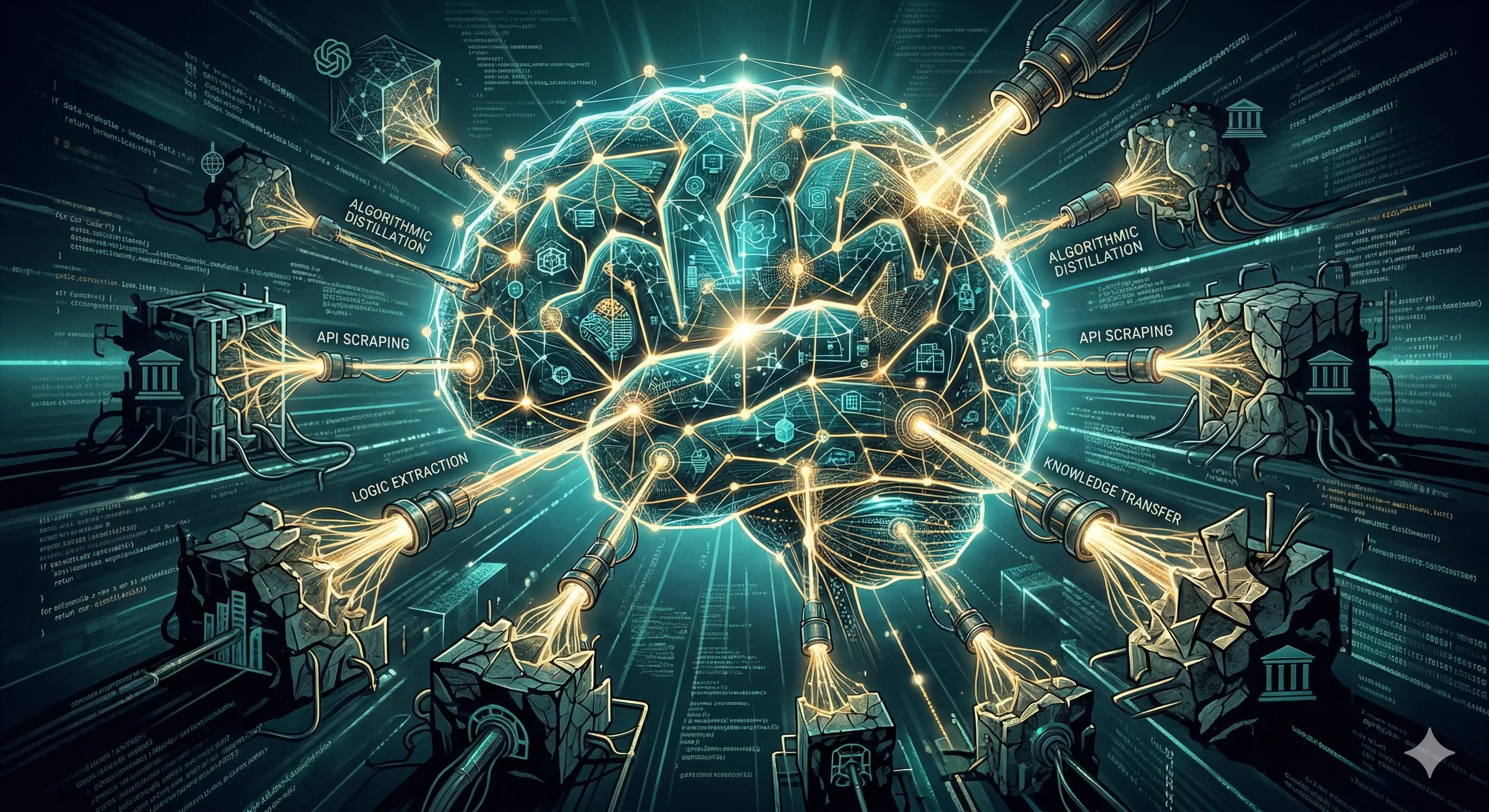
Distillation is the process of putting a cheaper, less capable 'student' system in a room with the master professor. Engineers take the student system and force it to observe millions of answers generated by Claude. They feed the master system highly complex prompts, record the brilliant, nuanced answers, and then use those exact outputs as foundational learning materials for the cheaper clone.
The result is a lightweight system that mimics the communication style, tone, and surface-level logic of Claude, but built at a fraction of the original computational cost. Instead of spending $500 million on a primary computation run, a lab might spend just $5 million on a distillation process.
The Core Accusation: Scraping Claude's Logic
The current 'distillation war' centers around claims that overseas research labs have systematically pinged Anthropic's APIs using automated scripts. By feeding millions of highly specific queries into Claude and hoarding the responses, these labs are accused of building competitive networks entirely on the back of Anthropic's massive capital expenditure.
This is highly controversial because it bypasses the hardest part of software development: creating the core algorithmic logic. It is the digital equivalent of copying someone else's homework right before the bell rings.
Anthropic’s Legal Reasoning Capabilities: What the Tool Actually Is
To really understand why competitors want to clone this specific system, you have to look at what Anthropic has built for the enterprise sector. Beyond standard text generation, Claude has evolved into a highly sophisticated legal reasoning tool.
So, what is this tool actually doing? Anthropic's enterprise suite is fundamentally a high-context document analysis engine. It features a massive 200,000-token context window, meaning it can ingest roughly 500 pages of dense legal text in a single prompt. Unlike traditional search-and-find software, it performs deep semantic mapping. It understands how a definition on page 4 alters an indemnity clause on page 112.
Step-by-Step: How Claude Processes Legal Documents
- Ingestion: The user uploads a massive volume of unstructured data (e.g., hundreds of PDF contracts).
- Semantic Mapping: The system maps out the logical dependencies, identifying defined terms, obligations, and liabilities.
- Cross-Referencing: It checks the ingested documents against a set of user-provided compliance rules or master service agreements.
- Output Generation: It produces a highly specific, legally-focused risk summary, flagging non-standard clauses and suggesting standardized revisions.
Real-World Mini Case Study: M&A Due Diligence
Consider a mid-sized corporate law firm handling a complex merger and acquisition. Traditionally, a team of junior associates would spend three weeks reading through 400 vendor agreements to find change-of-control provisions.
Using Anthropic's native reasoning engine, the firm uploaded the entire batch of 400 agreements into a secure enterprise environment. They prompted the system to isolate every contract that required explicit vendor consent within 30 days of a corporate merger. The system accurately identified 47 problematic contracts in under ten minutes, even catching instances where the wording was highly obscured. This is the kind of high-value reasoning power that foreign labs are allegedly trying to steal via distillation.
Comparing Workflows: Traditional vs. Native Engine vs. Distilled Clone
To see why the difference matters, let's compare how different systems handle complex enterprise tasks.
| Workflow Characteristic | Traditional Manual Process | Native Engine (e.g., Claude) | Distilled Clone System |
|---|---|---|---|
| Speed of Execution | Weeks to months | Minutes to hours | Minutes to hours |
| Logical Cohesion | High (Human logic) | High (Traces dependencies) | Low (Mimics style, loses deep logic) |
| Cost per Task | Extremely High (Billable hours) | Moderate (API costs) | Very Low (Cheap compute) |
| Edge-Case Reliability | High (If thorough) | High (Built-in reasoning paths) | Poor (Prone to severe hallucinations) |
Where This Breaks Down in Real Use
In real workflows, teams notice a distinct difference when using a genuinely native generative system versus a distilled clone. You might throw a complex 50-page vendor agreement at a cheaper clone, and on the surface, the summary looks completely fine. It uses the right vocabulary and sounds authoritative. But if you push it to find hidden indemnity clauses, it frequently hallucinates or just repeats the text verbatim without actually answering the question. A native system like Claude, however, actually traces the logical dependencies across different pages.
One issue that keeps coming up is the degradation of edge-case logic. This sounds efficient, but in practice, when you distill a massive neural network into a smaller one, you are essentially making a photocopy of a photocopy. The broad strokes are there, but the fine details vanish. When reviewing compliance mandates, a distilled clone will confidently skip over a subtle jurisdictional technicality because that specific pattern wasn't explicitly transferred during the original extraction phase.
Who Should NOT Use Distilled Systems
Given the appeal of lower costs, many businesses are tempted to integrate cheaper, distilled systems into their tech stacks. However, there are specific situations where these clones add very little value and introduce massive liability.
- Law firms and compliance departments: If your work involves binding legal agreements, regulatory filings, or strict compliance frameworks (like SOC2 or HIPAA), a distilled system is far too unreliable. The risk of hallucinated legal precedents is too high.
- Medical research institutions: Analyzing clinical trial data requires absolute precision. A clone system that mimics tone without possessing deep logical reasoning can misinterpret crucial dosage or side-effect correlations.
- Financial auditing teams: Parsing tax codes or corporate financial statements requires exact mathematical and contextual alignment, which lightweight clones routinely fail at.
The Hidden Risks (and Brief Pros) of Algorithmic Cloning
It is important to look at this objectively. There are reasons why distillation is so popular, but the risks are substantial.
The Pros:The primary advantage is cost. Distilled systems require significantly less computing power to run, making them ideal for low-stakes, repetitive tasks. If you just need a system to draft generic marketing emails or summarize casual internal meeting notes, a distilled network can save a company thousands of dollars in software licensing fees.
The Cons:The major downside is the illusion of competence. Because a distilled system learned by copying a highly intelligent master system, it adopts an incredibly confident, articulate tone. This makes it incredibly difficult for an average user to tell when the system is simply making things up. Furthermore, there are growing legal concerns. If a company relies on a system built via unauthorized scraping, they may eventually face intellectual property hurdles if the regulatory landscape tightens.
For a broader perspective on how intellectual property battles are shaping the technology sector, reputable technology coverage often highlights the ongoing tension between open-source sharing and corporate data protection.
Frequently Asked Questions
Is distillation actually illegal?
Currently, the legal landscape is very murky. Taking outputs from a public API to build a competing software product often violates the terms of service of the original company, but whether it constitutes outright intellectual property theft is still being debated in courts worldwide.
How can Anthropic tell if their system is being cloned?
Engineers can look for specific digital footprints. Sometimes, native systems are programmed with hidden 'watermarks'—specific, unique ways of phrasing certain edge-case answers. If a competitor's system starts repeating those exact unique phrases, it is a strong indicator of distillation.
Why are Chinese labs specifically being mentioned?
Due to heavy international trade restrictions on advanced microchips (like Nvidia's high-end GPUs), overseas labs often have limited access to the raw computing hardware needed to train massive foundational networks from scratch. Distillation offers a strategic workaround to this hardware bottleneck.
Can a distilled network ever be as good as the original?
Generally, no. It is limited by the specific data it was fed during the extraction process. It lacks the underlying architecture to reason through entirely novel problems that weren't included in its foundational learning materials.
Does this affect the average enterprise software user?
Yes. If you are buying third-party software that claims to have 'advanced reasoning capabilities,' you need to know what engine is actually powering it under the hood. A cheap clone could expose your business to operational errors.
Navigating the New Enterprise Landscape
The controversy surrounding the distillation war highlights a critical shift in the software industry. The barrier to entry for creating surface-level generative software has plummeted, but the barrier to creating genuinely reliable, enterprise-grade reasoning engines remains astronomically high.
For technology buyers, operations managers, and legal teams, the takeaway is clear: diligence is required when auditing your tech stack. You must start asking vendors hard questions about the origin and architecture of their analytical tools. Relying on a system that simply mimics intelligence is a liability waiting to happen in a high-stakes environment. Take the time to audit your current workflows, test your vendor's software against complex, multi-layered edge cases, and ensure you are relying on native reasoning rather than a cheap digital photocopy.
Disclaimer: The information provided in this article is for educational and informational purposes only. It does not constitute legal, financial, or professional advice. Readers should consult with qualified legal counsel regarding compliance, software licensing, and intellectual property matters.